
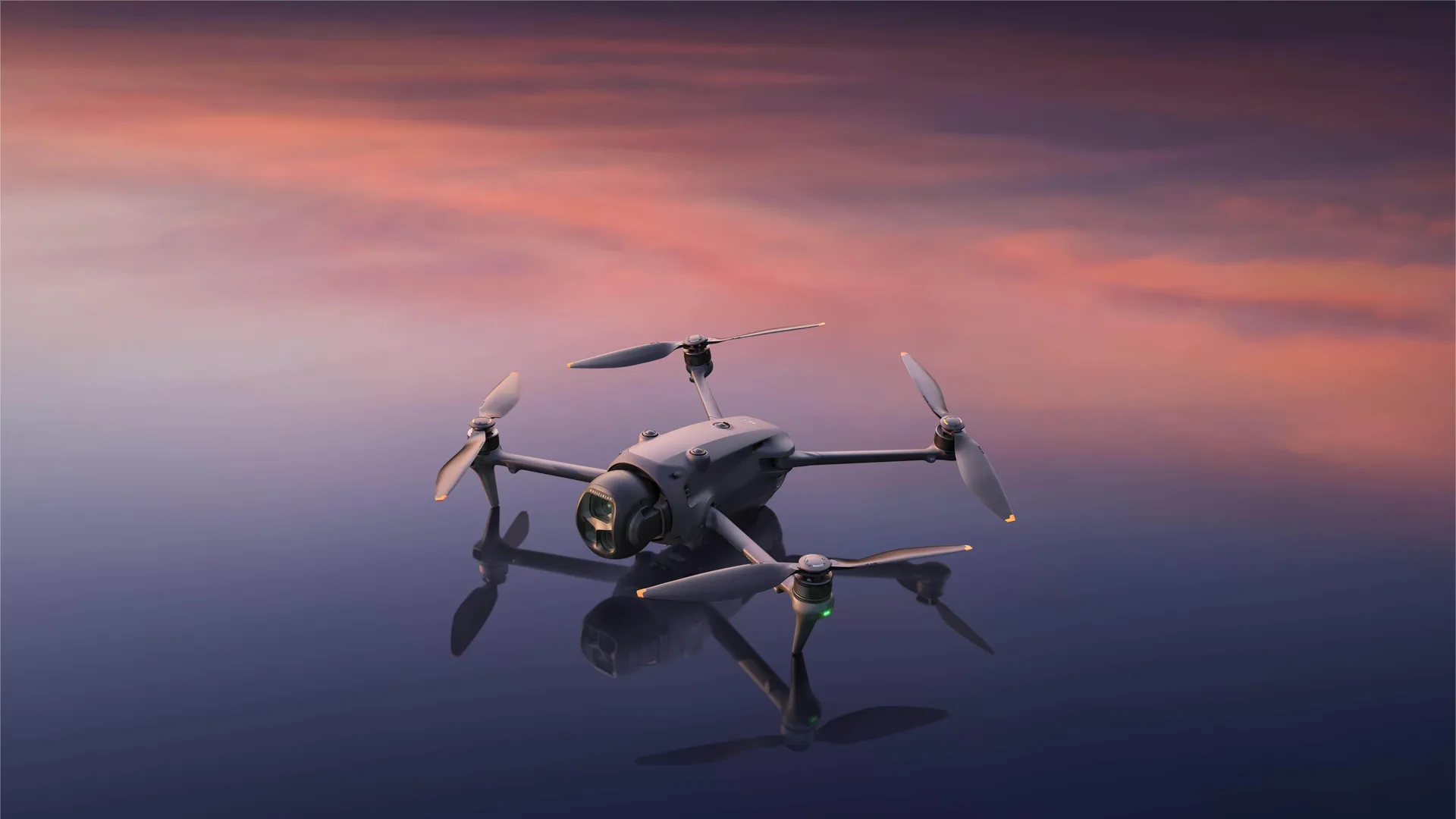
What makes a drone interesting to me isn't that it flies. It's what kind of camera it is in the air.
DJI introduced the Mavic 4 Pro in May 2025: a three-camera flagship carrying the Hasselblad name. In this piece I review the most complete bundle, the Creator Combo, through the eyes of someone who shoots hotels and resorts, commercials and fashion, line by line.
A note up front: the technical figures here are DJI's official specifications. Where I describe what happens in real use, I name whose observation it is. No made-up test results. The photos are DJI's too, taken from the product page and the press release.
What sets the Creator Combo apart
The Mavic 4 Pro is sold in different bundles; the Creator Combo is the most complete. Three things set it apart from the others:
- 512 GB of internal storage (about 460 GB usable). The standard version has 64 GB, of which about 42 GB is usable.
- H.264 ALL-I recording at 1200 Mbps. Only available on the 512 GB version.
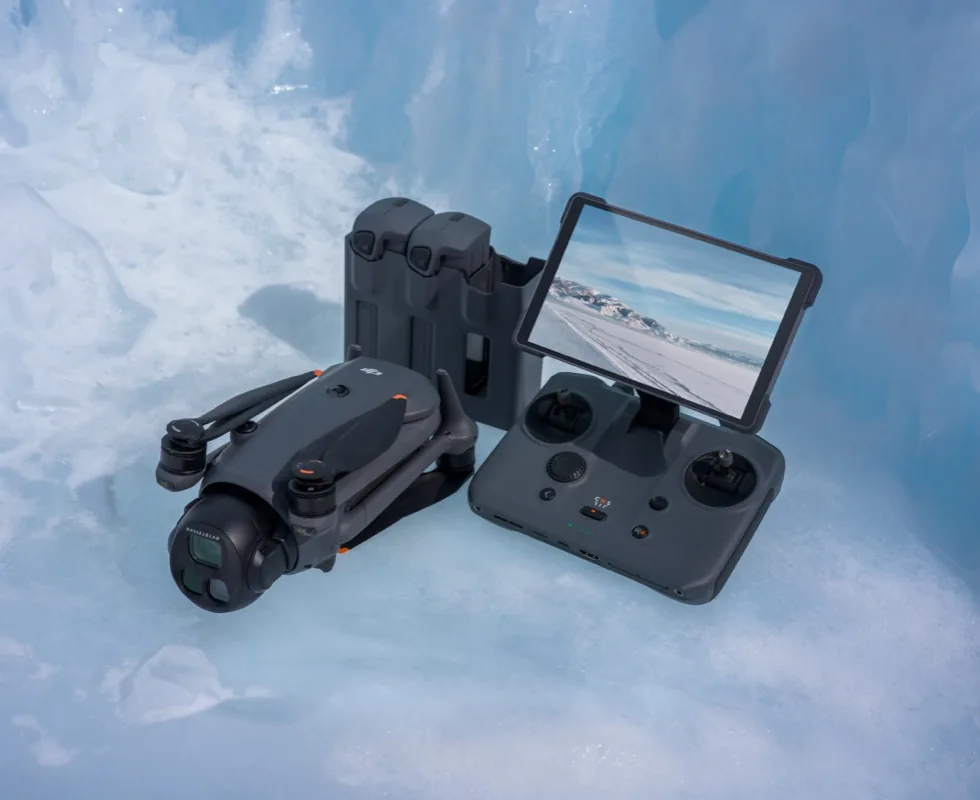
- The DJI RC Pro 2 controller.
In the box: the drone, the RC Pro 2, three Intelligent Flight Batteries, a parallel charging hub, a 240 W power adapter, a high-speed USB-C data cable, four pairs of spare propellers, a gimbal storage cover and a shoulder bag.
There are no ND filters in the box. For anyone shooting video, that is not a small detail; I'll explain why in a moment.
Three cameras, three different eyes
Main camera: Hasselblad, 28 mm. A 4/3-inch CMOS sensor, 100 megapixels, variable aperture from f/2.0 to f/11. The largest still is 12288 × 8192 pixels. On video, 6K (6016 × 3384) at up to 60 frames per second and 4K at up to 120.
Medium tele: 70 mm. A 1/1.3-inch sensor, 48 megapixels, f/2.8. 4K at 60 frames.
Tele: 168 mm. A 1/1.5-inch sensor, 50 megapixels, f/2.8. 4K at 60 frames.
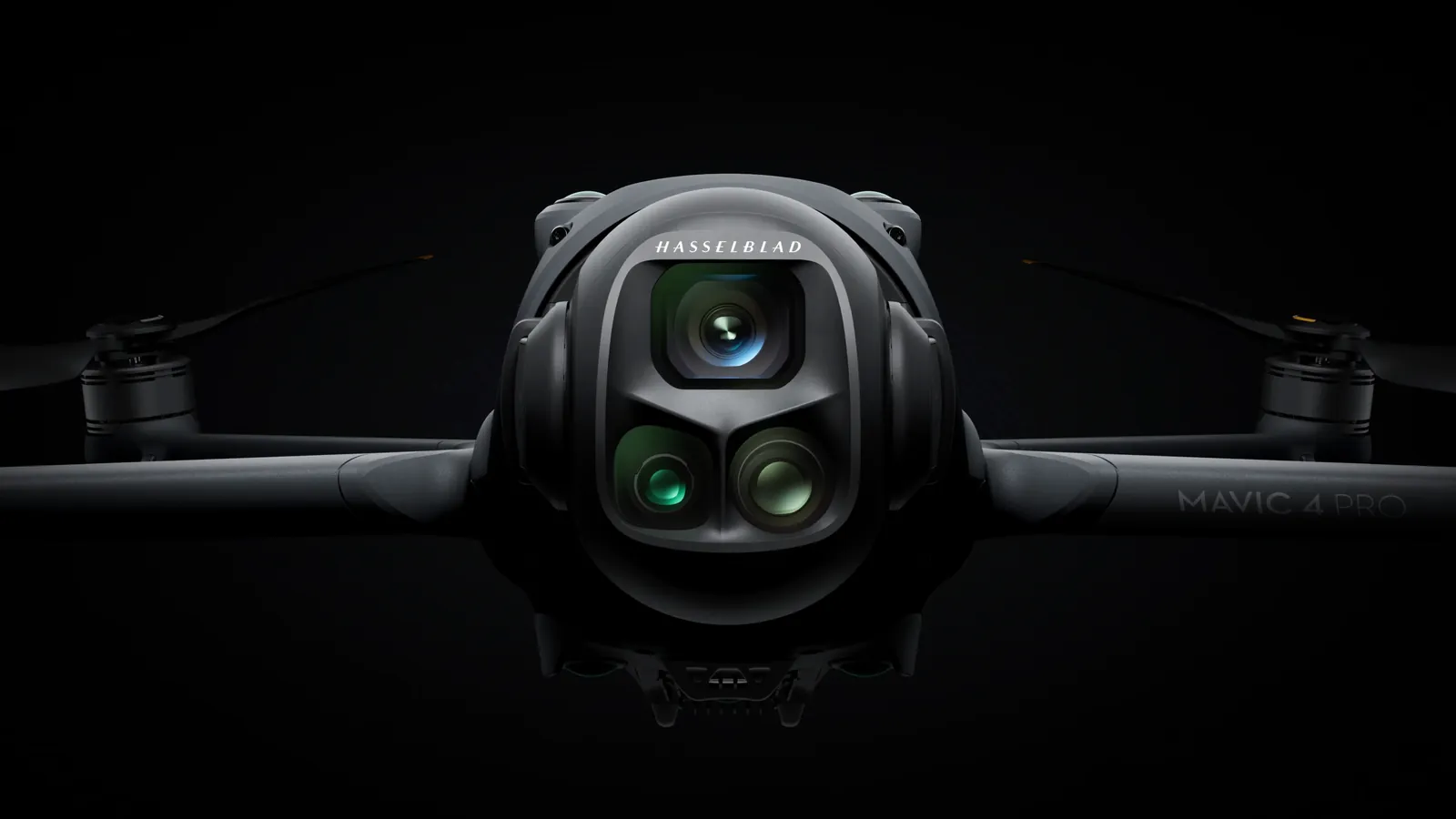
The biggest complaint about the previous generation was that the teles didn't carry the main camera's colour profiles. On the Mavic 4 Pro, all three cameras record 10-bit D-Log, D-Log M and HLG, and according to CineD's first look, the settings carry over when you switch cameras. Bringing all three cameras onto the same colour footing in the edit is now possible.
But you shouldn't treat the three as equals. As the sensor shrinks, so does the quality. In Engadget's test, the main camera's 6K and 4K footage was found "incredibly sharp and color-accurate"; the 70 mm's detail and low-light performance were weaker, and the 168 mm's video quality was rated "mediocre".
The practical takeaway for me is clear: the main camera is the working camera; the teles are framing tools.
Does the variable aperture replace ND filters?
No. But it makes the job easier.
Shooting at f/2.0 in Antalya's midday sun often means too much light, even at the fastest shutter speed. Being able to stop down to f/8 or f/11 makes exposure easier to control and increases depth of field for stills.
Video is a different story. For motion to look natural, the shutter speed needs to be around twice the frame rate: 1/50 at 25 frames, 1/100 at 50. In strong sun you can't hold that with the aperture alone; either the image blows out, or you push the aperture into the range where the image starts to soften. So if you're going to shoot serious video, an ND filter set should be bought separately. DJI's ND8, 16, 32 and 64 set is sold on its own.
The Infinity Gimbal: vertical shooting and looking up
The most talked-about new feature of the Mavic 4 Pro is the Infinity Gimbal: a three-axis mechanical gimbal that can rotate 360 degrees. It has two concrete benefits.
True vertical shooting. When you turn the RC Pro 2's screen 90 degrees, the gimbal rotates too and switches to vertical recording. No cropping, no loss of resolution. Today a hotel shoot's deliverables list includes as much vertical content as horizontal film; being able to shoot it from the air without cropping saves serious time.
Looking up. The gimbal can tilt up to 70 degrees. Frames that open up to the sky from beneath a bridge, an arch or a canopy are now possible.
Codec and storage: the Creator Combo's real difference
Standard recording is H.265, 10-bit 4:2:0, at up to 180 Mbps. Efficient, but heavy on the editing desk: the computer has to work to decode every frame.
The Creator Combo's H.264 ALL-I is something else. Every frame is recorded independently. Files get very large, but scrubbing back and forth on the DaVinci Resolve timeline becomes smooth and colour grading runs more comfortably.
A quick calculation: 1200 Mbps means roughly 150 MB per second, about 9 GB per minute. 460 GB comes to roughly 51 minutes of continuous ALL-I recording. A coincidence, but an interesting one: that matches a single battery's maximum flight time. In practice, offloading after every flight, the way you'd empty a card, is a must.
One omission: the Mavic 4 Pro doesn't record ProRes. The Apple ProRes option found on the previous generation's Cine version is gone this time. ALL-I is a good middle ground, but if your post-production pipeline runs on ProRes, factor that in.
Flight: 51 minutes on paper
DJI's maximum flight time is 51 minutes, but that's measured in level flight at a constant 32.4 km/h, at sea level, with no wind. Hovering, it's 45 minutes. Engadget saw 40–45 minutes in normal use. I'd plan accordingly: about 80 percent of the figure on paper.
The other figures:
- Weight: about 1063 g. In Europe it falls in the C2 class.
- Wind resistance: 12 m/s.
- Top speed: 25 m/s in Sport mode.
- Operating temperature: −10 to 40 °C.
That last one matters for Antalya. In July and August there are days when midday temperatures go above 40 degrees. One more reason to push flights to the morning and evening. The best light is at those times anyway.
Battery and charging
The battery is 6654 mAh, 95.3 Wh. Staying under 100 Wh matters for travel: lithium batteries under 100 Wh can generally go in cabin baggage. Still, check your airline's rules before you fly.
With the 240 W adapter, a single battery charges in 51 minutes and three batteries in 90. That means recharging all three during a lunch break on set.
Safety: night vision and LiDAR
Obstacle sensing is handled by a binocular vision system looking in every direction, supported by a forward-facing LiDAR. DJI says the system detects obstacles in all directions even in very low light, down to 0.1 lux. Forward detection range reaches up to 200 metres.
Independent tests find the system generally successful, but they show its limits too. In Engadget's night test it detected every obstacle; yet the reviewer also had a moment where it hit a small branch, and noted that it sometimes fails to detect small obstacles.
What it means for me: palm fronds and thin branches in hotel gardens are still a risk. Obstacle sensing is insurance, not piloting.
Transmission: O4+
With DJI O4+, the live feed arrives at 1080p and 60 frames per second, with latency around 130 milliseconds. Range is 15 km in Europe and similar regions, 30 km in the US. In Turkey you have to fly within visual line of sight anyway; range isn't the limit of the flight, it's its safety margin.
RC Pro 2: the monitor in the field
The controller is one of the reasons to choose the Creator Combo.
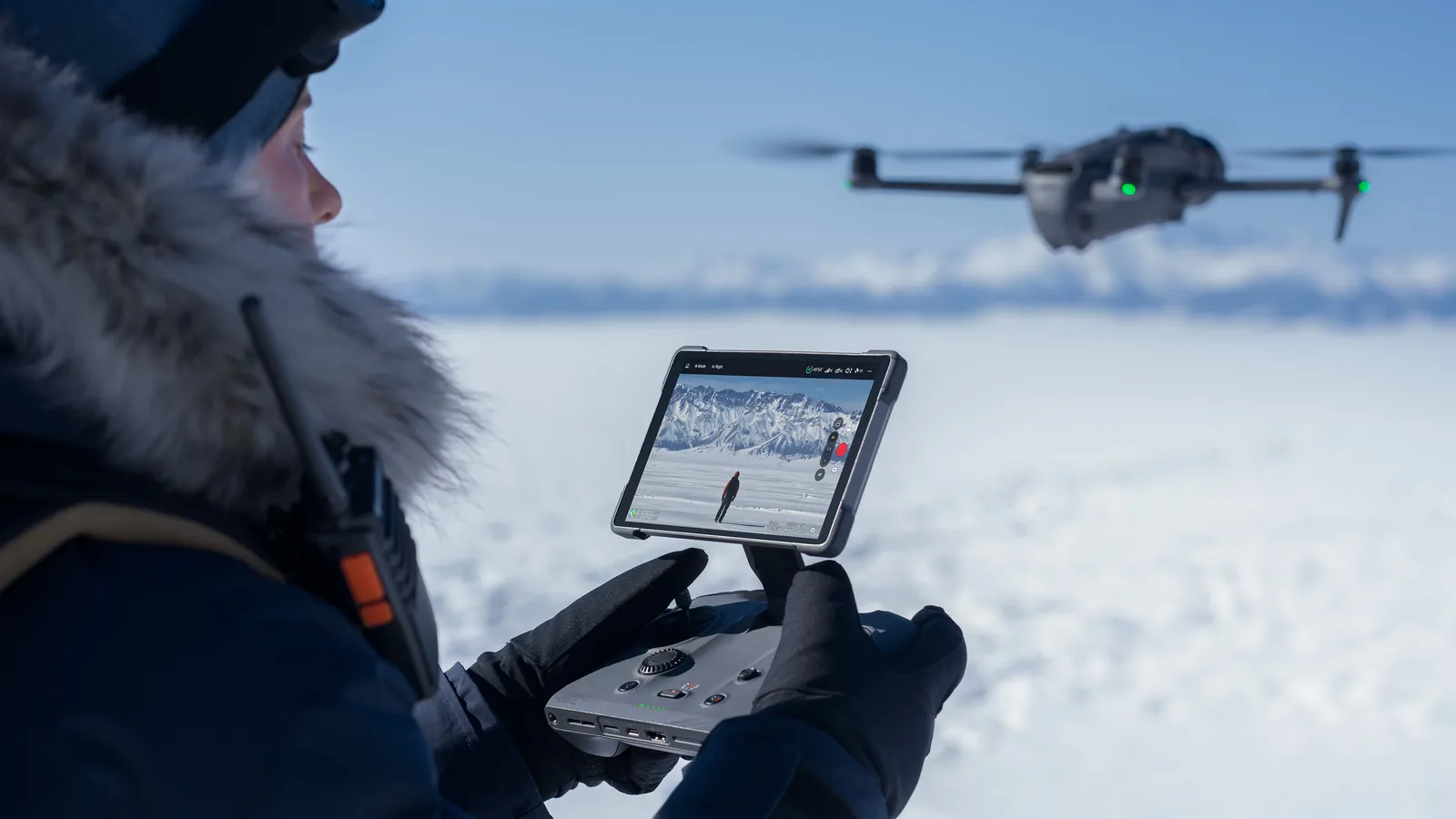
- A 7-inch mini-LED screen at 2000 nits. Being able to read the screen in Antalya's sun often means being able to nail the frame.
- A screen that folds and rotates 90 degrees. The most natural way to switch to vertical shooting.
- HDMI out. For the client or director to watch live on a separate monitor on set. On hotel shoots, that means wrapping up approvals in the field.
- Wi-Fi 6, USB-C, and sticks that retract into the body when the screen is folded.
Tracking and noise
In Engadget's test, ActiveTrack 360 kept up with a car travelling at about 48 km/h with obstacle avoidance on. Worth noting for anyone planning car or boat tracking for a commercial.
The noise level is the same as the Mavic 3 Pro, around 83 dB; but according to Engadget the pitch is lower and less grating on the ear. In a hotel full of guests, that detail matters.
The rules in Turkey
A 1063-gram drone can't simply be taken out of its box and flown freely in Turkey:
- SHGM registration: every drone of 500 grams or more must be registered in the UAV Registration System of Turkey's Directorate General of Civil Aviation, SHGM (iha.shgm.gov.tr).
- Pilot certificate: UAVs between 500 grams and 4 kilograms require an İHA-0 pilot certificate.
- Commercial shoots: paid work additionally requires commercial operation conditions, third-party insurance and a flight permit.
- Restricted areas: the area around airports and some other zones are restricted airspace. In Antalya, some of the beachfront hotels are very close to the airport.
The rules are updated from time to time; checking SHGM's current instructions before a shoot is a must. At a hotel, always get the property's written permission as well. I've covered drone planning for hotel shoots in detail in a separate piece.
What it gives me on hotel and resort shoots
- 28 mm Hasselblad: the opening shot and 100 MP stills. A resolution that leaves room to crop for brochures and large prints.
- 70 mm: pool lines, the rhythm of a facade, architectural compression. Focusing on a single idea instead of the wide angle showing the whole property.
- 168 mm: shooting from a distance. Framing the beach and the shoreline from afar without flying over guests. The right tool for privacy and safety.
- Vertical shooting: for social media cuts, without cropping, on a separate flight.
- 4K at 120 frames: for water. The pool surface, waves, splashes; everything that gains texture when slowed down.
- D-Log M: golden hour and blue hour. Bringing it onto the same colour footing as my Sony cameras on the ground in DaVinci.
- ALL-I: turnaround time. Hours saved on the editing desk mean faster delivery to the client.
Weak points
- No ProRes.
- The 168 mm's video quality is far behind the main camera.
- The 70 mm is weaker in low light.
- No ND filters in the box; buy them separately for video.
- Thin obstacles are still a risk.
- Weight: 1063 grams and, according to Engadget, a less agile flight character; none of the ease of the small-bodied models.
- Temperature limit: 40 °C; midday flights in an Antalya summer are borderline.
- Price: the Creator Combo is the most expensive bundle.
Who it's for
The Creator Combo's real value is the 512 GB and the ALL-I. Those two save time on the editing desk, and if you use the drone to earn money, that time is a direct cost.
For someone who flies occasionally and mostly shoots stills, the standard bundle is enough. If turnaround time, multiple focal lengths and vertical content are part of the job, the Creator Combo pays for itself.
From where I stand, the Mavic 4 Pro's biggest gain isn't a single feature; it's three cameras speaking the same colour language. An aerial shot only becomes part of a film when it speaks the same language as the footage on the ground.
The ordinary looks down from the air. The rebellious frames even in the air.